
What Are the Vedas? Understanding the Foundations of Ancient Indian Wisdom

Introduction: The World’s Oldest Living Knowledge Tradition
Across thousands of years, Bharat has preserved a remarkable stream of wisdom known as the Vedas. Scholars often describe them as the oldest surviving knowledge tradition in human civilisation. Generations of seekers, teachers, and families have turned to these ancient Indian scriptures for insight into life, ethics, and consciousness.
Many readers encounter the Vedas in fragments. A mantra heard during prayer. A reference in discussions on Indian philosophy. A quotation shared in spiritual literature. Often, the Vedas appear distant or mysterious. This leads to an honest question.
What are the Vedas?
Are they simply sacred books associated with ritual practices? Or do they represent a deeper knowledge system exploring the nature of existence, the human mind, society, and cosmic order?
To understand the Vedas meaning, we must approach them not merely as historical texts but as part of a living Vedic tradition that shaped Indian civilisation for millennia.
In this article, we explore the meaning of the Vedas, their role as ancient Indian scriptures, the structure of the four Vedas, and the broader Vedic knowledge system that includes Vedangas and Upavedas. We also reflect on the importance of the Vedas and the relevance of Vedic wisdom today.
What Are the Vedas? Understanding Their Meaning
The word Veda comes from the Sanskrit root vid, which means knowledge or understanding. The Vedas, therefore, represent knowledge discovered through observation, contemplation, and disciplined inquiry.
This meaning reveals something important about the Vedic tradition.
The Vedas were not written as dogmatic texts demanding belief. Instead, they emerged as reflections on reality and human experience. They contain hymns, prayers, philosophical insights, and reflections on nature and consciousness.
Within the Vedic knowledge system, these teachings address fundamental questions.
What is the nature of the universe?
How do human beings maintain harmony with cosmic order?
What is the relationship between mind and consciousness?
How should individuals live responsibly within society?

In classical Indian thought, the Vedas belong to a category called Shruti. The word Shruti means that which was heard. Ancient sages known as Rishis experienced profound states of awareness through meditation and contemplation. In these states, they gained insights into existence and expressed them in sacred hymns.
Because of this origin, the Vedas are not attributed to a single author. They represent a collective wisdom tradition developed across generations. Due to this, the Vedas are called "Apaurushey".
Over time, the teachings of the Vedas influenced many later streams of Indian thought, including Vedanta philosophy, classical Yoga, Ayurveda, and discussions about the mind that later contributed to the study of Vedic psychology.
Origins of the Vedas: A Tradition Preserved Through Memory
One of the most extraordinary features of the Vedic tradition is its method of preservation.
Unlike many ancient texts recorded in writing early on, the Vedas were transmitted orally for centuries. Teachers and students memorised the hymns with remarkable precision.
The oral tradition relied on sophisticated recitation techniques that ensured the accuracy of the text.
Students learned the exact pronunciation of each syllable. The rhythm and tonal accents of Sanskrit conveyed meaning in the chants. Several recitation patterns existed to prevent errors and preserve authenticity. These methods included repeating words in different sequences to facilitate the detection and correction of errors.

Through these practices, the ancient Indian scriptures remained remarkably consistent across generations. Historians often estimate that the earliest Vedic compositions emerged between 1500 BCE and 1200 BCE. Yet the intellectual traditions behind them may extend even further back within oral culture. What matters most is the continuity of the Vedic tradition that carried this knowledge forward.
Archaeological and linguistic studies suggest that the earliest Vedic hymns emerged during the second millennium BCE. However, the intellectual and cultural traditions behind them likely developed through long oral traditions before being compiled into structured collections.
The Four Vedas: Foundations of the Vedic Knowledge System
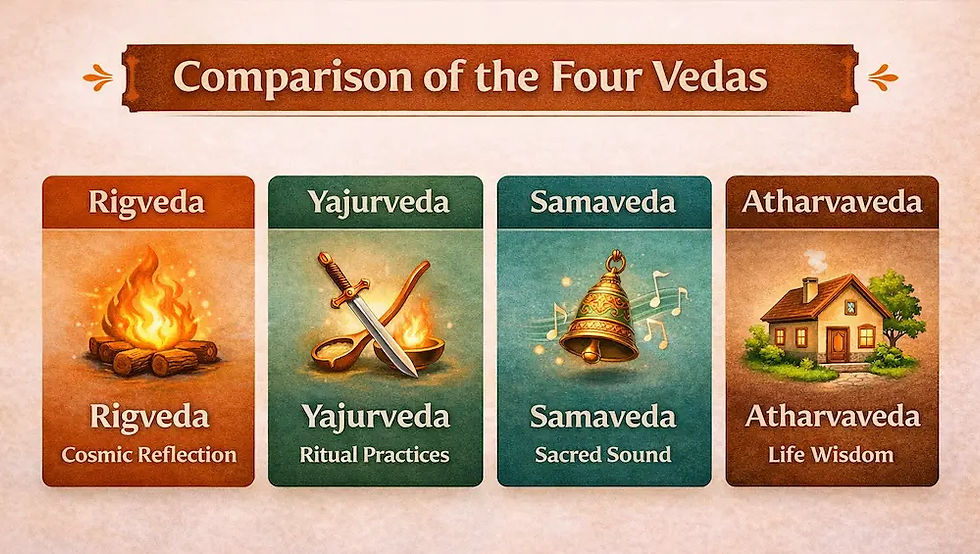
The Vedic tradition is organised into four primary collections. Each Veda contributes a distinct dimension to the broader Vedic knowledge system.
1) Rigveda: The Earliest Expression of Vedic Thought
The Rigveda is the oldest and most foundational of the Vedas. It contains more than one thousand hymns composed in poetic Sanskrit.
These hymns address cosmic forces such as Agni, Indra, Varuna, and Surya. Yet these references represent more than mythological figures. They reflect human attempts to understand natural forces and cosmic principles. A central idea within the Rigveda is Rta, the principle of universal order governing both nature and moral life.
The Rigveda's meaning, therefore, extends beyond ritual praise. It reflects early philosophical reflection on existence, nature, and cosmic harmony.
Some hymns ask profound questions about the origin of the universe and the nature of creation. These reflections represent some of the earliest expressions of philosophical thought in human history.
2) Yajurveda: The Knowledge of Sacred Action
While the Rigveda presents poetic hymns, the Yajurveda focuses on the structure and meaning of ritual practice. These rituals are known as yajnas. They were designed as acts of alignment between human activity and cosmic order.
The Yajurveda explains how these ceremonies should be performed and why they hold significance within the Vedic worldview. Ritual in this tradition was not mechanical. It represented disciplined participation in the harmony of the universe.
Through these practices, individuals expressed gratitude, responsibility, and awareness of their place within cosmic order.
3) Samaveda: The Veda of Sacred Sound
The Samaveda introduces the dimension of sacred sound within the Vedic tradition.
Many of its verses originate from the Rigveda but appear arranged as melodic chants. This collection represents one of the earliest traditions of sacred music.
These chants were used during rituals to create a focused and contemplative atmosphere.
The Samaveda highlights an important idea within Vedic wisdom. Sound influences consciousness.
This insight later shaped Indian musical traditions and practices involving mantra chanting.
4) Atharvaveda: Wisdom for Everyday Life
The Atharvaveda completes the fourfold structure of the Vedic knowledge system.
While it includes hymns and spiritual reflections, it also addresses practical aspects of life. These include health, social harmony, household practices, and protection.
Because of this wider focus, the Atharvaveda offers insight into the everyday concerns of ancient society. Its teachings reveal how the Vedic worldview extended beyond ritual spaces into the daily lives of families and communities.
Overview of the Four Vedas
Veda | Main Focus | Key Contribution |
Rigveda | Hymns and cosmic reflection | Early philosophical thought |
Yajurveda | Ritual procedures | Structure of yajnas |
Samaveda | Sacred music | Chanting and mantra tradition |
Atharvaveda | Everyday life and healing | Social and practical wisdom |
The Vedangas: Disciplines That Support the Vedas
As the Vedic tradition developed, scholars recognised the need for supporting disciplines that would help preserve and interpret the ancient texts accurately. These disciplines became known as the Vedangas, meaning limbs of the Vedas.
Just as limbs support the human body, these fields support the understanding and transmission of Vedic knowledge. Six Vedangas were developed within the tradition.
Shiksha focuses on phonetics and pronunciation. Since the Vedas were transmitted orally, correct pronunciation was essential.
Vyakarana studies the grammar of Sanskrit. It provides linguistic clarity that helps scholars interpret the meaning of Vedic verses accurately.
Chandas examines poetic meter and rhythmic structure within Vedic hymns.
Nirukta studies the meanings and origins of difficult words appearing in ancient hymns.
Jyotisha concerns astronomy and time calculation, helping to determine the appropriate timing of rituals and seasonal observances.
Kalpa describes ritual procedures and aspects of social conduct related to Vedic ceremonies.

Together, these disciplines formed a sophisticated educational structure that preserved the Vedic tradition with remarkable precision.
The Upavedas: Applied Knowledge Within the Vedic Tradition
Alongside philosophical study, the Vedic tradition also developed applied sciences known as the Upavedas. The word Upaveda means subsidiary knowledge. These disciplines translate Vedic principles into practical fields of life.
Four Upavedas are traditionally recognised.
Ayurveda focuses on health, longevity, and the balance between body, mind, and environment. It studies diet, lifestyle, seasonal rhythms, and preventive care.
Dhanurveda deals with martial training and military discipline. Ancient texts describe warfare as a responsibility governed by ethical principles.
Gandharvaveda explores music, sound, and performing arts. Indian classical music and dance traditions later evolved from this heritage.
Sthapatyaveda addresses architecture, construction, and spatial harmony. Principles of temple design and traditional urban planning emerged from this field.
Through the Upavedas, the Vedic knowledge system entered everyday life, shaping medicine, arts, architecture, and social organisation.
Key Philosophical Ideas in the Teachings of the Vedas
Beyond rituals and hymns, the deeper significance of the Vedas lies in their philosophical insights.
Several themes appear throughout Vedic literature.
Cosmic Order
The universe operates according to Rta, a principle of order that sustains harmony between nature, society, and individual life.
Knowledge and Self Inquiry
The Vedic worldview values inquiry and reflection. Later texts, such as the Upanishads, expand this pursuit into deeper discussions about consciousness and identity.
Harmony With Nature
Vedic hymns often celebrate natural forces such as fire, water, wind, and sunlight. This reflects an early awareness of humanity’s interconnected relationship with nature.
Core Ideas in the Vedic Worldview
The universe operates through Rta (cosmic order)
Knowledge emerges through observation and contemplation
Humans must live in harmony with nature
Consciousness is central to understanding life
Ethical living sustains social balance
From Vedic Wisdom to Indian Philosophy
The influence of the Vedas extends far beyond their earliest compositions.
Later traditions such as Vedanta philosophy, classical Yoga, and Ayurveda all draw inspiration from Vedic ideas. Vedanta explores the nature of consciousness and ultimate reality. Yoga philosophy examines the structure of the mind and the path to inner clarity. Subsequent discussions of awareness and mental processes within these traditions contributed to ideas associated with Vedic psychology.
These developments demonstrate that the Vedic knowledge system evolved continuously through interpretation and reflection.
Relevance of the Vedas Today

Many readers ask about the relevance of the Vedas.
Despite their ancient origins, the teachings of the Vedas continue to encourage reflection on timeless questions. They invite curiosity about existence. They promote respect for nature and ethical responsibility. They encourage individuals to examine their thoughts and actions with awareness.
In a time shaped by rapid technological change and constant information flow, the importance of the Vedas may lie in their invitation to slow down and reflect.
Vedic wisdom reminds us that knowledge is not limited to information. It includes understanding life, consciousness, and our relationship with the world.
Conclusion: Rediscovering an Ancient Source of Wisdom
When we ask what the Vedas are, we are not simply exploring ancient texts.
We are encountering one of the world’s oldest traditions of philosophical inquiry.
Through poetic hymns, disciplined rituals, and reflective dialogue, the Vedas explored the nature of reality, the structure of consciousness, and the ethical foundations of society.
These ancient Indian scriptures laid the foundations for many streams of Indian philosophy and cultural practice.
For modern readers, exploring the teachings of the Vedas offers more than historical knowledge.
It offers an opportunity to reconnect with a tradition that has examined the deepest questions of human life for thousands of years. Sometimes the oldest questions remain the most meaningful.
And within the quiet verses of the Vedas, those questions continue to invite reflection.
FAQs
What are the Vedas?
The Vedas are the oldest sacred texts of India and form the foundation of the Vedic knowledge system. The word “Veda” comes from the Sanskrit root vid, meaning knowledge. These ancient Indian scriptures contain hymns, philosophical reflections, rituals, and insights into nature, consciousness, and society. The Vedas were preserved through an oral tradition and are considered part of Shruti, meaning knowledge that was heard or revealed to ancient sages called Rishis.
What are the four Vedas, and what do they contain?
The four Vedas are Rigveda, Yajurveda, Samaveda, and Atharvaveda.
Rigveda – A collection of hymns exploring cosmic principles and natural forces.
Yajurveda – Instructions for rituals and sacred ceremonies called yajnas.
Samaveda – Melodic chants used in ritual recitation and sacred music.
Atharvaveda – Hymns addressing health, social life, protection, and daily concerns.
Together, they form the foundation of the Vedic tradition.
Why are the Vedas important in Indian philosophy?
The Vedas are important because they form the intellectual and spiritual foundation of many later Indian traditions. Philosophical systems such as Vedanta, Yoga, and Ayurveda draw inspiration from Vedic ideas about cosmic order, consciousness, ethics, and self-knowledge. They shaped the development of Indian philosophy, cultural practices, and spiritual traditions for thousands of years.
What are Vedangas and Upavedas?
Vedangas are six disciplines that support the study and preservation of the Vedas. These include phonetics, grammar, meter, etymology, astronomy, and ritual practice.
Upavedas are applied branches of Vedic knowledge. They include:
Ayurveda – Medicine and health
Dhanurveda – Martial science
Gandharvaveda – Music and performing arts
Sthapatyaveda – Architecture and spatial design
Together, they expand Vedic knowledge into practical fields of life.
Are the Vedas still relevant today?
Yes, many people continue to explore the Vedas for their philosophical insights and ethical reflections. The teachings of the Vedas discuss cosmic order, harmony with nature, self-inquiry, and responsible living. In modern times, readers often turn to Vedic wisdom for reflection on consciousness, human behaviour, and the deeper meaning of life.



Comments