
What Is Vedic Psychology? Understanding the Ancient Science of the Mind
Updated: Mar 29

Introduction: Did Ancient India Have Its Own Psychology?
Many people assume psychology began in modern universities and research laboratories. It often appears as a relatively recent scientific discipline, emerging in the last two centuries.
Yet thousands of years earlier, Indian thinkers were already reflecting deeply on the nature of the mind.
They examined questions such as:
What creates human suffering?
How do thoughts shape behaviour?
What is consciousness truly?
How does inner clarity transform life?
These reflections appear in ancient Indian texts such as the Upanishads, the Bhagavad Gita, and early Vedic literature. Together, they form what is now often described as Vedic psychology.
When we read these texts carefully, we see a thoughtful exploration of human awareness. The goal was not only intellectual understanding. The aim was inner stability and self-knowledge.
To understand Vedic psychology, we must examine how ancient Indian psychology conceptualised the relationship among mind, consciousness, and identity.
What Is Vedic Psychology
Vedic psychology refers to the ancient Indian understanding of the mind, consciousness, and human behaviour based on teachings found in the Vedas, Upanishads, and classical yoga philosophy.
Unlike modern psychological frameworks that focus mainly on behaviour and cognition, the Vedic view of the mind places consciousness at the centre.
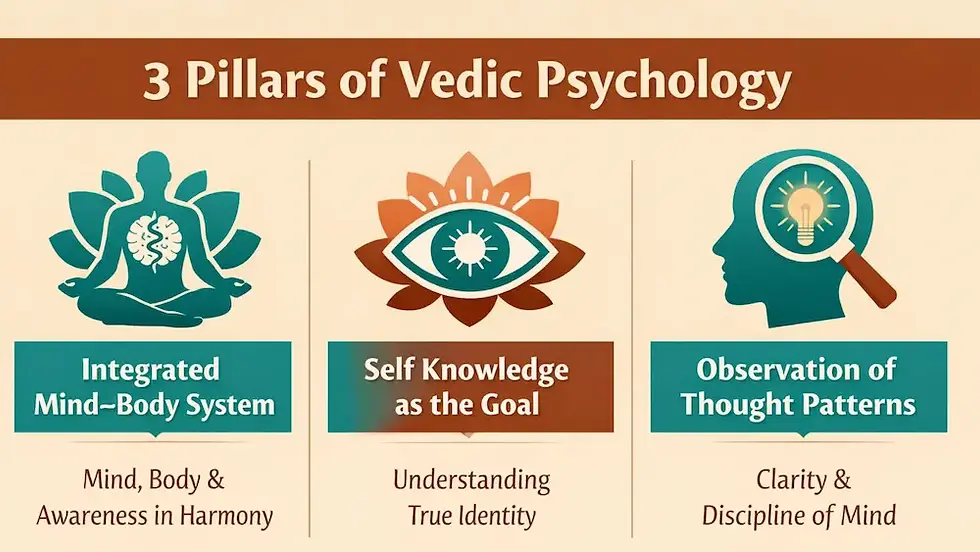
Several key characteristics define this approach.
First, it views the human being as an integrated system. Mind, body, and deeper awareness operate together rather than as separate compartments.
Second, the goal of inquiry extends beyond emotional stability. The tradition aims at self-knowledge and liberation from confusion about identity.
Third, mental clarity develops through disciplined observation of thought patterns, actions, and motivations.
Within the broader Indian philosophy of mind, psychological insight becomes part of spiritual inquiry. The study of the mind is not only therapeutic. It is transformative.
This deeper exploration forms the foundation of what many scholars describe today as ancient Indian psychology.
Origins of Vedic Psychology in Ancient Texts
The roots of Vedic psychology are evident in several foundational texts of Indian thought.

Rigveda
The earliest hymns include reflections on awareness, perception, and the inner life of human beings. These early verses already show interest in consciousness and order within the human mind.
Upanishads
The Upanishads examine the nature of the Self and the structure of inner awareness. They ask questions about identity, perception, and the difference between the mind and deeper consciousness.
Bhagavad Gita
The Gita offers practical guidance on emotional regulation, decision making, and the management of desire and attachment. It discusses the nature of the restless mind and methods to stabilise it through discipline.
Yoga Sutras of Patanjali
These classical aphorisms present a systematic approach to understanding thought patterns and mental fluctuations. They explain how focused attention and meditation bring clarity.
Across these texts, psychology in the Vedas emerges as an exploration of consciousness rather than merely behaviour. The Vedic understanding of consciousness treats awareness as fundamental to human experience.
The Vedic Model of the Mind
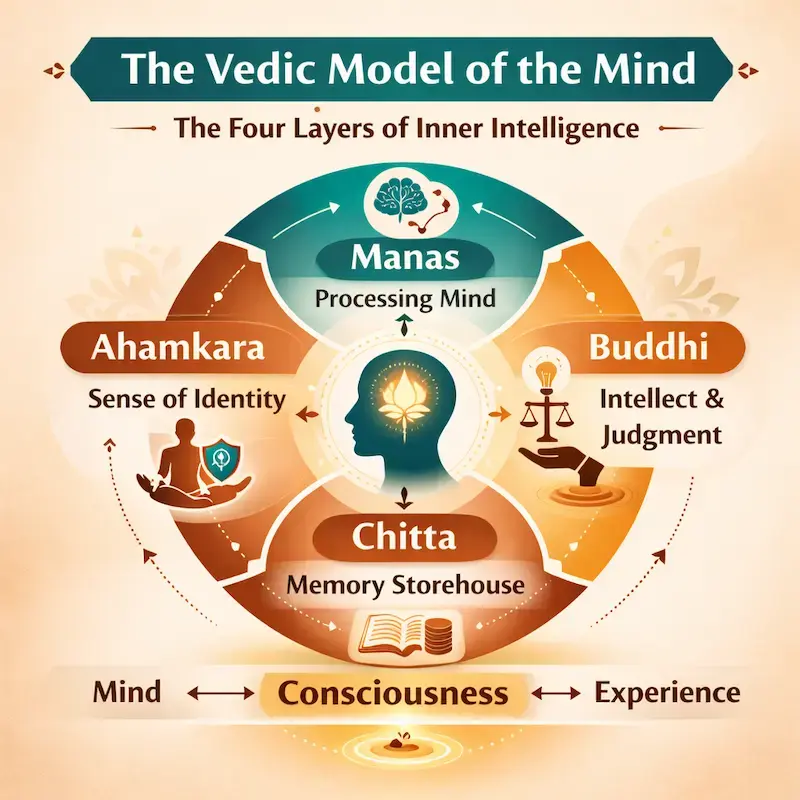
Ancient Indian thinkers developed a sophisticated model describing various aspects of the mind. Four components are often discussed.
Manas - The Processing Mind
Manas receives sensory information and processes everyday thoughts. It reacts to sights, sounds, and emotions. This is the layer where moment-to-moment thinking occurs.
Buddhi - The Intellect
Buddhi represents discernment and reasoning. It evaluates choices and determines direction. A refined buddhi allows thoughtful decisions rather than impulsive reactions.
Chitta - The Memory Field
Chitta stores impressions and past experiences. Every action, emotion, and memory leaves subtle traces. These impressions influence future reactions and tendencies.
Ahamkara - The Ego Identity
Ahamkara forms the sense of personal identity. It creates the feeling of I and mine. This structure helps organise experience but also generates attachment and conflict when it becomes rigid.
These four aspects interact continuously.
Manas receives impressions. Chitta stores them. Ahamkara interprets them through identity. Buddhi evaluates them through discernment.
This layered understanding forms the core of the Vedic concept of mind and consciousness.
Core Concepts in Vedic Psychology
Concept | Meaning | Role in Psychology |
Manas | Processing mind | Handles sensory thoughts |
Buddhi | Intellect | Discernment and decision making |
Chitta | Memory field | Stores impressions and experiences |
Ahamkara | Ego identity | Creates a sense of “I” |
Consciousness: The Core of Vedic Psychology
Perhaps the most important distinction within Vedic psychology lies between mind and consciousness.
The mind is a tool. Consciousness is the witnessing presence.
The Mandukya Upanishad and the Brihadaranyaka Upanishad describe consciousness as the underlying reality within which thoughts arise and dissolve. This deeper awareness is referred to as Atman.
In this perspective, thoughts do not define identity. They appear and disappear within consciousness.
The Vedic view of the self, therefore, shifts the focus from controlling thoughts to understanding their nature.
When a person recognises the difference between the mind and the observing awareness, emotional turbulence gradually loses intensity. Within consciousness in Vedanta, self-knowledge becomes the foundation of mental clarity.
The Role of the Three Gunas in Human Psychology
Another important concept in Vedic psychology is the theory of the three gunas. These qualities describe patterns of mental energy.

Sattva
Sattva represents clarity, balance, and wisdom. A sattvic mind tends toward calm reflection and ethical action.
Rajas
Rajas represents activity, ambition, and restlessness. A rajasic mind seeks movement, achievement, and stimulation.
Tamas
Tamas represents inertia, resistance, and confusion. A tamasic state often produces lethargy or avoidance.
The Bhagavad Gita explains that these qualities exist in varying proportions within every individual. They influence behaviour, motivation, and emotional response.
Understanding the meaning of sattva, rajas, and tamas allows a person to observe inner tendencies more clearly. Rather than labelling behaviour as good or bad, the guna framework invites awareness of underlying mental states.
Vedic Psychology and Modern Psychology
Modern psychology has developed valuable tools for understanding behaviour, emotional health, and cognitive patterns. Clinical research and therapeutic methods provide important support for mental well-being.
Vedic psychology approaches the mind from a slightly different perspective.
It places greater emphasis on consciousness as the foundation of identity. The aim extends beyond symptom relief toward deeper self-understanding.
Modern psychology often focuses on emotional stability and behavioural adjustment. Vedic psychology seeks insight into the nature of the Self.
Both perspectives offer meaningful contributions.
When examined together, ancient Indian psychology and modern psychology provide complementary views of human experience.
The Emerging Role of Vedic Psychology in Counselling
In recent years, a small but growing number of counsellors and therapists have begun exploring Vedic psychology in psychological counselling. This approach integrates traditional insights about mind, awareness, and emotional patterns with modern therapeutic methods.
The number of practitioners using this framework remains limited. Yet its potential is significant. Concepts such as observing thoughts, understanding ego identity, and recognising mental tendencies align naturally with many counselling techniques.
For individuals seeking deeper self-reflection, the Vedic understanding of consciousness provides an additional dimension within modern psychological guidance.
Why Vedic Psychology Matters Today
Life today moves quickly. Constant information, digital distraction, and social pressure create mental restlessness.
Ancient teachings offer a different rhythm of understanding. Vedic psychology encourages careful observation of thought patterns, awareness of emotional tendencies, and refinement of attention through reflection and meditation.
This approach does not reject modern knowledge. It adds a layer of philosophical depth to the study of the mind. For many readers exploring ancient wisdom traditions, the Vedic view of the mind offers practical guidance for inner balance.
Conclusion: Rediscovering an Ancient Science of the Mind
Long before modern psychology departments existed, Indian sages were studying the mind through disciplined observation and meditation. Their reflections were recorded in hymns, philosophical dialogues, and yogic teachings.
Modern interest in meditation, mindfulness, and self-awareness has renewed attention toward ancient Indian psychology. Many of these contemporary practices echo insights found in Vedic and yogic teachings thousands of years ago.
Vedic psychology invites us to see the mind not as a problem to eliminate, but as an instrument of awareness. When understood clearly, the mind becomes a bridge between daily life and deeper consciousness. And through that understanding, the search for inner clarity begins quietly within.
Subscribe to OneMoreThing
Get Stories like this in your inbox
FAQs
What is Vedic psychology?
Vedic psychology is the ancient Indian understanding of the mind, consciousness, and human behaviour based on teachings from the Vedas, Upanishads, Bhagavad Gita, and Yoga philosophy. It views the human mind as part of a larger system that includes body, intellect, memory, and consciousness. Unlike modern psychology, which often focuses on behaviour and cognition, Vedic psychology emphasises self-knowledge and awareness as the foundation of mental clarity.
What are the four components of the mind in Vedic psychology?
Vedic psychology describes four aspects of the mind:
Manas – the processing mind that receives sensory information and everyday thoughts
Buddhi – the intellect responsible for reasoning and discernment
Chitta – the memory field storing impressions and past experiences
Ahamkara – the ego identity that creates the sense of “I” and personal ownership
These elements interact continuously and shape human behaviour and perception.
How is Vedic psychology different from modern psychology?
Modern psychology primarily studies behaviour, cognition, and emotional health through scientific methods. Vedic psychology focuses on consciousness and the nature of the Self (Atman). While modern approaches aim to treat mental distress and improve functioning, Vedic psychology seeks deeper self-knowledge and liberation from confusion about identity. Many scholars see the two approaches as complementary.
What are the three gunas in Vedic psychology?
The three gunas describe fundamental qualities of mental energy:
Sattva – clarity, balance, and wisdom
Rajas – activity, ambition, and restlessness
Tamas – inertia, confusion, and resistance
According to the Bhagavad Gita, these qualities exist in varying proportions in every individual and influence behaviour, motivation, and emotional tendencies.
Can Vedic psychology be used in modern counselling?
Some counsellors and therapists are beginning to integrate Vedic psychological concepts into modern counselling practices. Ideas such as observing thoughts, understanding ego identity, and recognising mental tendencies align with mindfulness and cognitive approaches. While still emerging, Vedic psychology can offer philosophical depth and complementary insights for personal growth and emotional understanding.


Comments