
The Story Behind “Jab Zid Pe Aa Gayi Parvati, Samjhane Pahunche Saptarishi”
Updated: Sep 27

You must have liked the recent song from Hanuman Ansh, “Jab Zid Pe Aa Gayi Parvati, Samjhane Pahunche Saptarishi.” Its earthy language, devotional mood and playful description of Bholenath make it difficult to hear only once.
But behind those memorable lines lies an older and much deeper story.
Why did the Saptarishis come to Parvati?
Why were they trying to convince her to reconsider Shiva?
And why did Parvati remain so firm despite everything they told her?
The song compresses a fascinating episode from the Shiva tradition into a few folk-style lines. At its heart is a story of tapasya, devotion, discernment and unwavering resolve.
To understand the song, we have to return to Parvati's story.
Why Did Parvati Want to Marry Shiva?
Parvati is traditionally described as the daughter of Himavan, the personification of the Himalayas, and Mena. In several Hindu traditions, she is also understood as the rebirth of Sati, Shiva's earlier consort.
Her attraction toward Shiva is therefore not presented as an ordinary romantic choice.
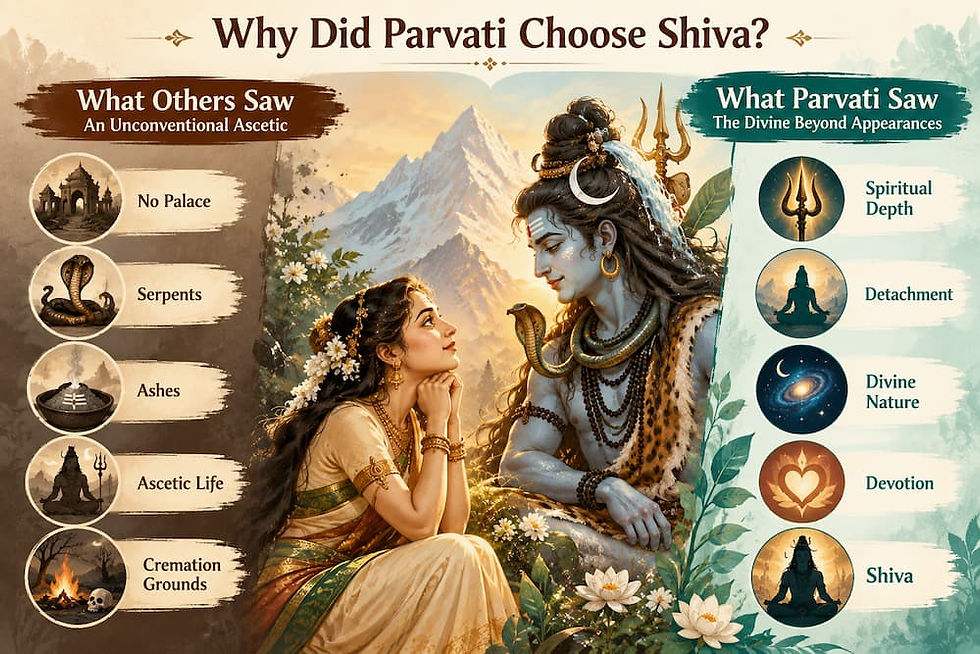
Parvati chooses Shiva despite his complete difference from conventional ideas of royalty, comfort and worldly status. Shiva lives as an ascetic. He has matted hair, wears ashes, carries the Ganga in his hair and is associated with serpents, cremation grounds and beings outside ordinary social conventions.
To many people, Shiva does not look like an ideal bridegroom. Parvati sees something else. Her choice becomes an expression of spiritual recognition and unwavering devotion.
The details of her story differ across Puranic traditions and later retellings. In some versions, the Saptarishis are sent specifically to test her determination. In Kalidasa's Kumarasambhava, the seven sages appear later in the story as representatives who formally approach Himavan regarding the marriage. The song follows the former narrative pattern, where the sages try to reason with Parvati.
(At a Glance) What is the story behind “Jab Zid Pe Aa Gayi Parvati”?
“Jab Zid Pe Aa Gayi Parvati, Samjhane Pahunche Saptarishi” is a folk-style retelling of the story of Parvati’s determination to marry Shiva. The Saptarishis approach her and try to change her mind by pointing out Shiva’s unusual ascetic lifestyle. Parvati remains devoted and refuses to abandon her resolve.
Parvati's Tapasya: When Determination Became Devotion
Parvati does not simply express her desire and wait. She undertakes tapasya.
The word tapasya comes from tapas, associated with heat, austerity and disciplined spiritual effort. In the traditional narrative, Parvati's austerities become increasingly intense as she remains focused on Shiva. Her determination attracts the attention of the gods and sages. Yet the important point is not the physical difficulty of her austerities. It is her steadiness.

She does not abandon her purpose when the path becomes difficult. Her desire for Shiva becomes a sankalpa, a deeply held resolve supported by discipline.
This is why the word “zid” in the song becomes interesting. In everyday language, zid often means stubbornness. But Parvati's determination is presented differently within the traditional story.
She is not simply insisting on getting what she wants. She is remaining committed to a path after deep reflection and sustained tapasya. There is a difference between ego-driven stubbornness and disciplined resolve. The song captures this distinction through humour, while the underlying story gives it spiritual depth.
Why Did the Saptarishis Come to Parvati?
Now we reach the line everyone remembers:
“Jab zid pe aa gayi Parvati, samjhane pahunche Saptarishi.”
When Parvati's determination becomes unshakable, the Saptarishis arrive.
In the Shiva Purana tradition, Shiva sends the seven sages to examine the depth of Parvati's devotion. They speak with her and attempt to change her mind. The episode presents their visit as a test of whether her determination comes from temporary emotion or deeper conviction. And this is precisely where the song becomes entertaining.
The sages look at Shiva from an ordinary worldly perspective and essentially ask:
Why him?
Why choose someone who lives such an unusual life?
Why perform such severe tapasya for a man who has little interest in worldly comforts?
The questions sound almost like concerned elders trying to protect someone from making an unconventional marriage choice. Except this is Parvati. And she is not changing her mind.
What Did the Saptarishis Tell Parvati?
The song turns their argument into playful folk poetry.
They point toward everything unusual about Shiva.
He has Ganga flowing from his head.
He wears serpents around his neck.
He has matted locks.
He smears ashes on his body.
He has no palace.
He wanders as an ascetic.
He is associated with cremation grounds.
He appears frightening and unconventional.
The song's humour comes from presenting all these characteristics as reasons why Parvati should reconsider. “Why choose such a groom?”
It is almost as if the sages are conducting an ancient marriage counselling session. The difference is that their candidate is Mahadeva.
The folk lyrics exaggerate the contrast between Parvati's royal upbringing and Shiva's ascetic life. The official song description itself presents the episode as the Saptarishis trying to reason with Parvati about the simple and unworldly Bholenath. Yet the deeper narrative is more serious. The sages are testing her understanding. Is she attracted to an image? or does she understand Shiva's deeper nature?
Parvati Refuses to Be Dissuaded
The sages' arguments do not shake her. This is one of the most beautiful aspects of the story. The Saptarishis see the external Shiva. Parvati sees something deeper. She does not judge Shiva through wealth, appearance, social status or conventional ideas of comfort.
Her devotion has already passed through tapasya. She has endured hardship. She has remained steady.
And now her understanding is being tested through words. The Shiva Purana tradition describes the sages attempting to deter her and then returning to Shiva after witnessing her firmness. The episode therefore becomes more than a story about marriage.
It becomes a story about discernment. Parvati is not blindly stubborn. She knows what she has chosen.
Then Shiva Tests Parvati Himself
The story does not end with the Saptarishis. Shiva himself tests Parvati. According to the Shiva Purana tradition, Shiva approaches her in disguise and speaks critically about Shiva. He describes the very qualities the sages had questioned.
Parvati does not accept the criticism. Instead, she defends Shiva. The disguised ascetic's arguments fail.
Shiva eventually reveals his true identity. Her devotion has passed the test. The symbolism here is subtle.
Parvati is not merely being rewarded for wanting Shiva strongly enough. Her tapasya has demonstrated steadiness, discernment and devotion. She has remained committed even when the person she seeks is described in the least flattering terms.
From Tapasya to Marriage
Once Parvati's devotion is established, the story moves toward marriage. In Kalidasa's Kumarasambhava, the Saptarishis later approach Himavan formally on Shiva's behalf, and the marriage preparations begin. The poem presents the sages in a different role from the one highlighted in the song. This difference matters.
Indian mythology has never existed through one single storytelling format. Puranas, classical Sanskrit poetry, regional traditions, temple traditions and folk songs often preserve different episodes, emphases and narrative details.
The song therefore should be understood as a devotional folk retelling of a recognised mythological theme, rather than as a word-for-word presentation of one single scripture. That is also why the song feels so natural. It takes a grand mythological episode and brings it into the language of ordinary people.
What Does This Story Really Teach Us?
The story of Parvati and the Saptarishis offers several reflections.
First, determination is not always stubbornness. Sometimes a person stays firm because they have thought deeply about what they value.
Second, appearance does not reveal the whole nature of a person. The sages describe Shiva through his unusual appearance and lifestyle. Parvati looks beyond those external features.
Third, tapasya changes the seeker. Parvati's austerity is not presented merely as a method for obtaining a desired result. It becomes a process through which her resolve becomes deeper and steadier.
And finally, devotion requires patience. Parvati does not abandon her path because the result does not appear immediately. Her devotion survives delay, difficulty and doubt.
Why the Song Feels So Different
Perhaps this is why “Jab Zid Pe Aa Gayi Parvati” has connected so strongly with listeners. It does not present Shiva and Parvati as distant figures trapped inside a formal religious narrative. Instead, it brings them into a familiar human setting. There are elders giving advice. There is a determined young woman refusing to change her mind.
Unconventional qualities are being questioned. And there is a bridegroom whose lifestyle makes everyone wonder whether this marriage will work. The humour makes the story accessible. The devotion gives it depth. And the mythology gives it memory.
The Deeper Meaning of Parvati's “Zid”
There is perhaps one more thought worth carrying from the story. Parvati's “zid” is meaningful because it is supported by tapasya. She does not merely say, “I want Shiva.”
She disciplines herself for what she believes in. She remains steady when others question her. She looks beyond appearances. And she continues with patience. This gives the song's central line a different meaning.
“Jab zid pe aa gayi Parvati” is not simply about a woman refusing to listen. It is about a resolve that has become strong through devotion.
The Next Time You Hear the Song
The next time you hear “Jab Zid Pe Aa Gayi Parvati, Samjhane Pahunche Saptarishi,” you may hear more than a catchy devotional song from Hanuman Ansh. You may hear the playful voice of the sages questioning Parvati.
You may hear the description of Shiva as Bholenath, the ascetic with Ganga in his hair and serpents around his neck. And beneath the humour, you may hear something quieter.
Parvati knows what she has chosen. The Saptarishis test her. Shiva tests her. Yet her resolve does not disappear.
Perhaps this is why the story continues to speak across generations.
It asks a simple question:
When everyone around you questions the path you have chosen, do you know deeply enough why you chose it?
Sometimes the deepest stories of Bharat do not ask us merely to admire their characters.
They quietly ask us to examine our own resolve.
Why did the Saptarishis come to Parvati?
According to the Shiva Purana tradition reflected in this story, the Saptarishis came to Parvati to test and challenge her determination to marry Shiva. They questioned her choice by pointing out Shiva’s ascetic lifestyle, unusual appearance, and lack of worldly comforts. However, Parvati remained firm in her devotion and resolve.
Why did Parvati want to marry Shiva?
Parvati’s desire to marry Shiva is traditionally connected with her deep devotion and her previous existence as Sati, Shiva’s earlier consort. Her choice is not presented simply as an ordinary romantic attraction. Through intense tapasya, Parvati demonstrates her determination to unite with Shiva despite the differences between his ascetic life and her royal upbringing.
What is the meaning of “Jab Zid Pe Aa Gayi Parvati”?
The phrase “Jab Zid Pe Aa Gayi Parvati” describes Parvati’s unwavering determination to marry Shiva. Although the word “zid” usually means stubbornness, the story gives it a deeper meaning. Her determination is supported by tapasya, patience, discipline, and devotion, making it closer to a deeply held spiritual resolve than ordinary stubbornness.
Did Shiva also test Parvati before marrying her?
Yes. In the Shiva Purana tradition, Shiva is described as testing Parvati himself. He approaches her in disguise and speaks critically about Shiva, highlighting the same unconventional qualities that the Saptarishis had questioned. Parvati refuses to accept the criticism and continues to defend Shiva, after which Shiva reveals his true identity.
Is the story of Parvati and the Saptarishis found in the same form in every Hindu text?
No. Different Hindu texts and traditions present the story with variations. The Shiva Purana contains an episode in which the Saptarishis test Parvati’s determination, while Kalidasa’s Kumarasambhava presents the Saptarishis later approaching Himavan in connection with Shiva and Parvati’s marriage. Regional traditions and folk songs may further adapt the story.


Comments