
What Does “Hanuman Ansh” Really Mean? Understanding Neem Karoli Baba Through the Idea of Hanuman Bhakti
Updated: Sep 28
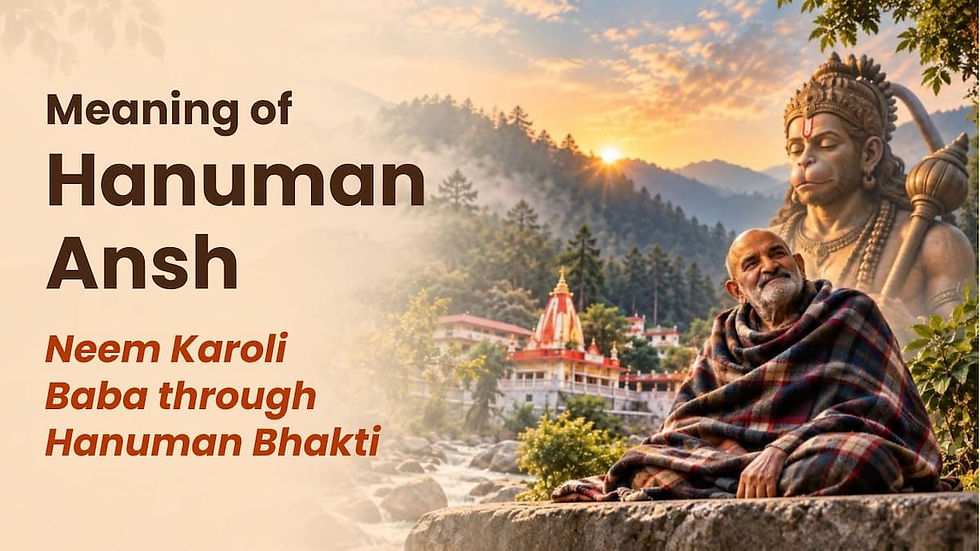
There is a phrase increasingly associated with Neem Karoli Baba in conversations about Indian spirituality: Hanuman Ansh. The phrase sounds simple, but it raises a deeper question.
What does it mean when devotees call a human being an “Ansh” of Hanuman?
The phrase Hanuman Ansh has also gained fresh attention through the movie Hanuman Ansh, which has been receiving interest and appreciation from audiences. The growing conversation around the film has led many people to explore the deeper meaning of the phrase and its connection with Hanuman Bhakti. But beyond the movie and popular discussion, the idea of Hanuman Ansh has a much deeper place within devotional language and the way devotees understand Neem Karoli Baba.
Does it mean the person is literally Hanuman?
Or does the expression point toward something more subtle, where the life of a saint reflects the qualities traditionally associated with Hanuman?
This distinction matters.
Neem Karoli Baba, also known as Maharaj-ji, is remembered by his devotees as a deeply devoted practitioner of Hanuman bhakti. Kainchi Dham, the ashram most closely associated with him, continues to attract devotees who connect his life with devotion, service, compassion, and remembrance of God.
At the same time, describing someone as Hanuman Ansh belongs to the language of devotional faith. It is not a historical or scientific classification.
Perhaps the more meaningful question is not whether Neem Karoli Baba was literally Hanuman.
It is this:
What does it mean to live with the qualities of Hanuman?
What Does Hanuman Ansh Mean?
The Sanskrit word ansha generally means a part, portion, or aspect.
Within devotional traditions, however, such expressions often carry a spiritual meaning rather than functioning as a literal biological statement.
When devotees describe Neem Karoli Baba as Hanuman Ansh, they are expressing a perception of his profound connection with Hanuman and the qualities associated with Hanuman bhakti.
These qualities include:
Bhakti, or devotion; Seva, or selfless service; Humility; Strength used for service; Surrender to the divine
Neem Karoli Baba's association with Hanuman is well documented within the devotional tradition surrounding him. His followers remember him as a Hanuman devotee, and accounts connected with his life repeatedly emphasise love, service, remembrance of God, and compassion.
So, the Hanuman Ansh meaning is best understood within the language of devotion.
It expresses spiritual resemblance rather than a claim that historians or science could independently establish.
Why Is Neem Karoli Baba Associated With Hanuman?
To understand this connection, we need to understand Hanuman himself.
In the Ramayana tradition, Hanuman represents extraordinary strength combined with extraordinary humility. He possesses immense capability, yet he directs it toward Rama. His greatness does not come from wanting recognition. It comes from service.
This makes Hanuman one of the clearest embodiments of Bhakti in Hindu tradition.

Neem Karoli Baba's remembered teachings similarly place devotion and service at the centre of spiritual life. Ram Dass, one of his best-known disciples, described Maharaj-ji's teaching through three simple ideas: loving everyone, serving everyone, and remembering God.
That connection helps explain why devotees perceive something Hanuman-like in him. The comparison rests less on appearance or identity and more on qualities.
Bhakti: The First Connection
The first quality is Bhakti. Hanuman's devotion to Rama is not presented as a transaction. He does not serve Rama because he expects wealth, status, or reward. His service itself is his expression of love.
Neem Karoli Baba is similarly remembered through the language of devotion. His spiritual approach is generally described as centred on love of God, particularly through Hanuman and Rama.
This offers an important understanding of Hanuman devotion.
Bhakti is not simply performing rituals. It is allowing devotion to shape how you live.
For a devotee, calling Neem Karoli Baba Hanuman Ansh can therefore express the perception that his life reflected this quality of complete devotion.
Seva: When Devotion Becomes Action
The second quality is Seva. Hanuman's devotion never remains theoretical. When Rama needs help, Hanuman acts. He crosses the ocean. He searches for Sita.
He carries the Sanjeevani mountain. He serves without asking whether the work is prestigious.
This is why Hanuman has become such a powerful symbol of selfless service.
Neem Karoli Baba's remembered teachings also place service at the centre of spiritual practice. Accounts preserved by the Love Serve Remember Foundation describe his message in terms of loving, feeding, and serving others.
This gives the Hanuman Ansh idea a practical dimension. If someone sees a saint as reflecting Hanuman, the important question becomes: Does his life encourage us to serve?
That question is more useful than debating the label itself.
Humility: Strength Without Self-Importance
Hanuman possesses enormous strength. Yet the Ramayana does not present him as consumed by his own greatness. His strength exists for Rama's purpose. This combination is unusual.
Strength without humility easily becomes pride. Humility without strength can become helplessness.
Hanuman represents another possibility: immense capability guided by surrender. Devotees remember Neem Karoli Baba in a similar spirit. Stories about him often portray a teacher whose emphasis was less on building a formal philosophical system and more on love, service, compassion, and direct spiritual experience. This is one reason the comparison with Hanuman continues to resonate among his followers.
Surrender: The Heart of Hanuman Bhakti
Hanuman's relationship with Rama also represents Samarpan, or surrender. Surrender does not mean weakness. It means placing one's ego, effort, and personal desires within a larger purpose.
Hanuman acts with extraordinary energy, yet he does not claim the work as his personal achievement. This is perhaps one of the deepest lessons in the Hanuman Ansh idea. A person might possess intelligence, influence, wealth, or spiritual knowledge. But what happens when the ego becomes smaller than the purpose?
The answer, in the devotional understanding, is service. Neem Karoli Baba's influence on Ram Dass offers an interesting example of this orientation. Ram Dass described Maharaj-ji as his guru and later wrote extensively about love, service, devotion, and Hanuman. He also received the name Ram Dass, meaning servant of Ram.
Kainchi Dham and the Living Tradition of Hanuman Bhakti

Kainchi Dham has become one of the most recognised places associated with Neem Karoli Baba.
Located in Uttarakhand's Kumaon region, the ashram is closely associated with Hanuman worship and continues to attract visitors seeking darshan and spiritual connection.
For many devotees, visiting Kainchi Dham is therefore not simply a visit to a historical site.
It is an encounter with a living devotional tradition.
The connection between Neem Karoli Baba and Hanuman is experienced through temple worship, stories of Maharaj-ji, remembrance, and the continued practice of seva.
This distinction is important. A tradition remains alive through practice.
Devotional Belief and Historical Fact
A thoughtful discussion of Neem Karoli Baba should keep two perspectives separate. Devotees may sincerely believe that he was an aspect or manifestation of Hanuman. This belief belongs to the devotional and spiritual interpretation of his life.
Historical research, meanwhile, deals with biographical evidence, contemporary accounts, institutional records, and documented events. There is no universally accepted historical or scientific method for establishing that a particular human being is literally an incarnation or ansh of Hanuman.
This does not invalidate devotional belief. It simply keeps different forms of knowledge in their proper places. Faith asks questions of meaning and spiritual identity. History asks what evidence exists. Both deserve clarity.
So, Was Neem Karoli Baba Hanuman?
For a devotee, the answer might be expressed through faith. For historical inquiry, there is no established evidence that permits the statement as a factual conclusion. But perhaps there is another way to approach the question.
Look at the qualities.
Bhakti.
Seva.
Humility.
Strength.
Surrender.
These are the qualities through which Hanuman is remembered and worshipped.
These are also qualities repeatedly associated with Neem Karoli Baba by his devotees and spiritual lineage. Perhaps “Hanuman Ansh” is less about claiming to be Hanuman and more about living with the qualities of Hanuman. That interpretation does not require a devotee to abandon faith.
It gives faith a practical direction.
What Hanuman Ansh Can Mean for a Seeker Today
The deeper lesson may be available even to someone who does not use the term literally.
Ask yourself:
Can strength become service?
Can devotion become compassion?
Can success exist without arrogance?
Can spiritual practice reduce ego rather than increase it?
Can love become an action rather than merely an emotion?
These questions bring Hanuman bhakti into ordinary life. A parent serving a family with patience. A professional using knowledge to help others. Someone feeding a hungry person without seeking recognition. A person remembering the divine while performing everyday duties. These acts might appear ordinary. Within the tradition of Bhakti, they carry another meaning. They become seva.
Conclusion: Beyond the Label
The fascination with Neem Karoli Baba and the phrase Hanuman Ansh is understandable.
His connection with Hanuman, his influence on generations of devotees, and the continuing importance of Kainchi Dham have created a devotional legacy extending far beyond his lifetime. Yet the deepest meaning of the phrase may not lie in proving an extraordinary identity. It may lie in understanding an extraordinary ideal.
Hanuman represents devotion without pride, strength without arrogance, service without expectation, and surrender without weakness. Neem Karoli Baba's devotees saw these qualities reflected in his life.
Whether one accepts the phrase Hanuman Ansh as a matter of faith or approaches it symbolically, the spiritual question remains valuable. What would happen if we tried to live with a little more Bhakti, a little more Seva, and a little less ego?
Perhaps that is where the meaning of Hanuman Ansh becomes most relevant. Not in declaring who a saint was. But in asking what his devotion inspires us to become.
What is the devotion of Hanuman?
Hanuman's devotion is traditionally understood as complete bhakti, surrender, and selfless service to Shri Rama. His devotion is characterised by unwavering remembrance, humility, freedom from personal expectation, and using his strength in service of a higher purpose.
What does Hanuman Ansh mean?
Hanuman Ansh uses the Sanskrit word ansha, meaning a part, portion, or aspect. In devotional usage, describing Neem Karoli Baba as Hanuman Ansh expresses a perceived spiritual connection with Hanuman and qualities associated with him, such as devotion, seva, humility, strength, and surrender.
Was Neem Karoli Baba Hanuman?
Some devotees believe that Neem Karoli Baba was an aspect or manifestation of Hanuman. From a historical perspective, there is no established way to independently prove that a particular human being was literally Hanuman. The connection is therefore best understood within the context of devotional faith.
Why is Neem Karoli Baba associated with Hanuman?
Neem Karoli Baba is strongly associated with Hanuman through the devotional tradition surrounding his life and teachings. He is remembered for his devotion to Hanuman and Rama and for emphasising love, service, compassion, and remembrance of God. Kainchi Dham is also closely associated with Hanuman worship.
What can Hanuman Ansh teach us today?
The idea of Hanuman Ansh can be understood as an invitation to cultivate qualities traditionally associated with Hanuman, including devotion, humility, selfless service, strength guided by purpose, and surrender. Its practical lesson is to turn devotion into compassionate action and seva in everyday life.


Comments